Pietro Mascagni Wants to Forget
Composer Leaves His Troubles Behind Him During His Visit to California
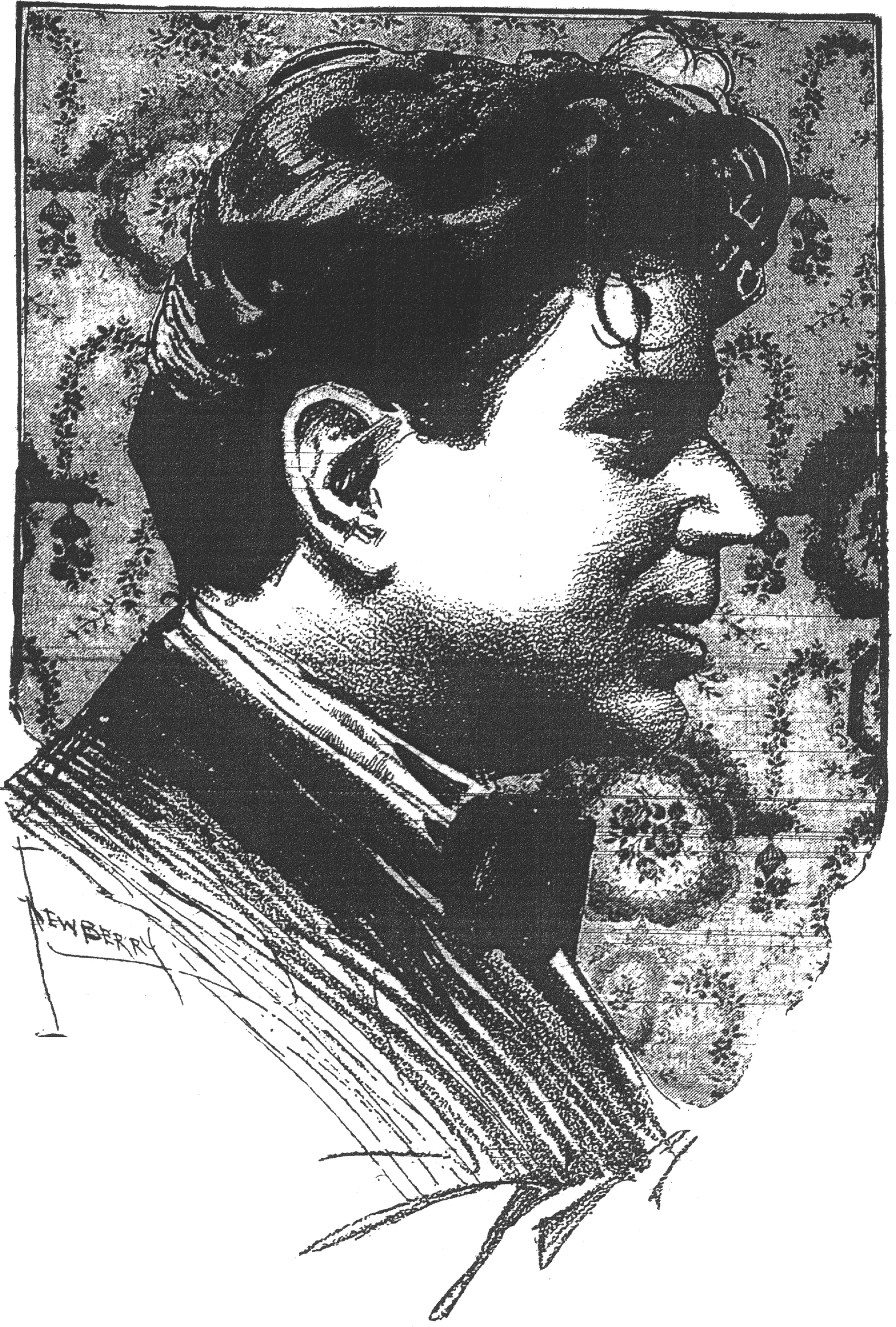
(San Francisco Examiner, February 1903)
[Original portrait caption: “Composer of ‘Cavalleria Rusticana.’ — This is a portrait of Pietro Mascagni, the composer. Across the face of the picture is a section of the score of the Intermezzo, which made him famous.”]
Pietro Mascagni, who ranks among the greatest of modern composers, arrived in San Francisco yesterday morning at 8:25, and before 9 o'clock he received by wire an offer to direct Channing Ellery's Italian band at St. Louis!
The great maestro came to California to forget his troubles, and this telegram certainly contributed to that end, for he laughed all day over it.
"A composer and symphony director leading a military band!" he would exclaim with both jeweled hands in the air, and then explode in laughter.
"But that is not the most absurd offer that has been made me in this good country of commerce," he explained through his friend, I. E. Patrezi of "L'Italia," for this interpreter of the mysteries of great music requires an interpreter when dealing with a great language. "While I was in Chicago the manager of a vaudeville house offered me $2,500 a week to play the 'Intermezzo' twice a day on the piano."
Then he sat down at the piano and gave an imitation of the Maestro Mascagni droning the great melody for a vaudeville audience.
"They might as well have suggested a barrel organ, and the funniest part of the whole matter is that I came near accepting it. Now in Europe such an offer would have been regarded by a composer as a gross insult. Here I realized that it was merely a business proposition — a matter of dollars and cents — and no offense was intended. The money did not tempt me, but the man who made the offer was so offended at my declination that I nearly yielded."
Tires of the Intermezzo
"Do you ever get tired of your own Intermezzo?" was asked.
"Sometimes I do," he laughed. "When I find people who demand that one melody and wait and will be satisfied with nothing else, I become heartily disgusted with it. If they appreciate other music whether my own or another composer's work, I understand their desire to hear what they may regard as the gems of my own compositions. In Germany, where I directed symphony concerts and interpreted Wagner, Beethoven, Tchaikowsky and other composers, the people demanded the Intermezzo too, but it was not the only thing they appreciated. In some places in this country many have made inquiries as to the hour the Intermezzo would be played, and they came to hear that and nothing else."
"What induced you to come to America?"
"The flattering persuasions of an impresario. I had received offers for two or three years, but had thought little of them. Then a man came to me with an offer that appeared so good that it tempted me. His description of the country and the people interested me and created a desire to visit America. Altogether I was persuaded."
"And what do you think of the people from a musical point of view, now that you are here?"
"They have a great virtue that may become a great fault. They undoubtedly have a great passion for music, but it is blind and undiscriminating. They are so full of nervous, energetic activity that they must have recreation, and when they seek it in music they do not care much what it is so long as it furnishes pleasing diversion. They are easily carried away by a novelty be it a composer or a performer. He pleases them; that is enough. Thus many Europeans who are secondary performers and hardly known abroad come to this country and become great favorites. This is a great step up the ladder, for when they return to Europe they are sometimes considered seriously. All the people of this country require is artistic development. They are as familiar with all new compositions here as they are in the capitals of Europe, and if they cared to take the trouble could form just as good an estimate of their respective merits, but they do not listen to criticise, but to be entertained. Those who entertain the best are most appreciated."
Instructs and Entertains
"In presenting your programmes, do you desire to instruct or entertain?"
"Neither and both. Those who go to my concerts want certain popular features, they pay for them and they are entitled to them. Therefore they get them. Still my principal desire is to show that I am not merely a composer of an Intermezzo and that I can interpret my own music. I want to show my audiences that I am broadminded enough to be able to comprehend and interpret the works of other composers, and particularly the classics."
The maestro is young, handsome, broad-shouldered and athletic. He is full of nervous energy, and is as restless as a caged bear. He drums at the piano, smokes incessantly and occupies every chair in his apartments all within the space of five minutes. His face is strong without being heavy featured; his hand is large without being ponderous; his frame is large and heavy without being bulky and inelastic. He is evidently a man of moods without being moody. Above all he is a typical Italian with no suggestion of a patois nor a trade.
The wife of the maestro accompanies him. She is a genial young woman, who shows a penchant for jewels and bric-a-brac. She is delighted with great strings of Indian bead work bought on the way to California. They will be in San Francisco about three weeks and will visit all nearby points of interest, for the maestro says California is like Italy even if the skies are not sunny in winter. Here he is to forget his troubles, and nothing will induce him to discuss them.