How Parisina was Born
Historical Article
This article was written by Mascagni in late 1913 on the eve of the La Scala premiere and published in La Lettura in January 1914. See also the original Italian version.
There is a curiosity that almost always piques me whenever I hear news of a new opera. How was it born? How did the first thought flash into being — the thought that, as it was worked out, gave life (or in some cases, Heaven forbid, death) to the work? It was a curiosity that used to seem very easy to satisfy. Yet now that I have just finished writing Parisina, if I ask myself how it was born and wish to be conscientious, I have to answer myself:
— Hold on a moment, my friend, let me put my thoughts in order.
Here is how it happened. Truthfully, the backstory — that is, the first approaches between the publisher and the Poet — is unknown to me. At a certain point I learned that a libretto had arrived in secret at the publisher's, and later I learned that this libretto was by D'Annunzio, and that the publisher Lorenzo Sonzogno wanted a meeting with me. I went to see him, and he said to me:
— What would you say if I offered you a libretto by Gabriele D'Annunzio to set to music?
I asked at once: — An adaptation?
— No, no, an original libretto.
— What? D'Annunzio has written an opera libretto? And for whom did he write it?
— For question marks.
And he showed me the manuscript, on whose title page, in magnificent calligraphy in red and black ink, stood written: “Parisina, lyric tragedy by Gabriele d'Annunzio set to music by ??????????”.
— Would you like to cover those question marks with the letters of your first and last name?
— Why, that is impossible — said I — because there are ten question marks, and my first and last name come to fourteen letters.
— We shall ask D'Annunzio to add four more question marks.
The idea was so charming that I could not resist, all the more because an original libretto appealed to me. Many years ago I had already entered into negotiations with the Poet on other occasions; I was supposed to write an Orlando innamorato with him. Yet there was always a danger in setting a tragedy by Gabriele D'Annunzio to music. And the thought of that danger came back to me even at that moment when Lorenzo Sonzogno presented this libretto to me: “What if I say yes, and then prove unable to set it to music? What if the libretto is not suited to my temperament? What if D'Annunzio has not managed to confine his winged poetry within the straitjacket of a work for the lyric stage? Everyone would take it out on me: D'Annunzians, anti-D'Annunzians, my friends, my enemies. It would be ruinous.” So I told Sonzogno:
— Before accepting, I set one condition: I ask for twenty days to give you an answer.
Sonzogno was kind enough to agree.
In the libretto, those question marks carried what I might call a valuation scale. In the contract drawn up between the Poet and the publisher, the Poet priced the question marks on the following basis: he had placed different composers into different categories. If it was a well-known composer, the fee requested by the Poet had one value — say, ten. If it was for an unknown composer, then the fee went up — fifty. Naturally, I did not trouble myself to find out in which category the Poet would have placed me. And I took the libretto — or rather, I refused even to take it then. I simply told the publisher that I was leaving for Rome, and Sonzogno came to Rome and handed me the libretto. In turn, I handed him a letter stating that within twenty days I would give a definitive answer. And during those twenty days I set to studying it. Except that the publisher, impatient to give the Poet an immediate reply — or perhaps at the prompting of the Poet himself — decided to send a telegram to D'Annunzio saying that I would be the one to set Parisina to music. Naturally that telegram left me somewhat perplexed, for who knew whether D'Annunzio would be pleased with the choice? Still, on April 23 I telegraphed D'Annunzio myself as follows: “I have accepted Parisina.” My perplexity lasted only briefly, because the very next day D'Annunzio answered me with this gracious and affectionate telegram: “Thank you. I expect great things. I shall come to meet you whenever you please. I have much to tell you. I shake your hand. Gabriel.” At that time we still addressed each other formally. I told the publisher:
— I need to hear this entire tragedy declaimed by the Poet.
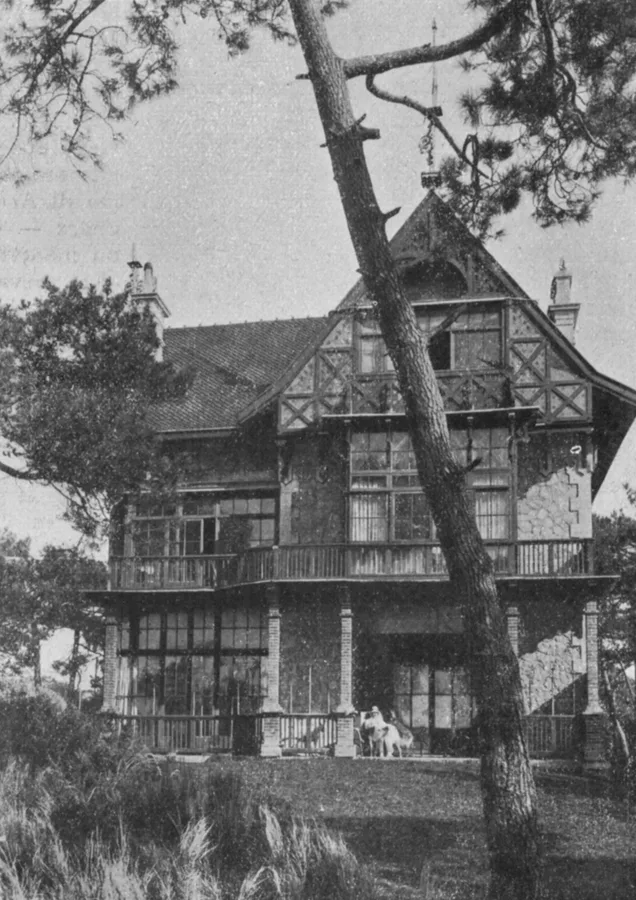
in Arcachon.
I remember that I did not yield to the curiosity of reading the tragedy through at a single sitting. Not only did I read the first act and then reread it, pausing over everything that made the strongest impression on me, but every time I felt as though I had come up against an obstacle, I went back and reread. I wanted to penetrate the spirit of the tragedy. Indeed, it took me no fewer than five days to read it. And after those five days I had still not made up my mind, because at certain moments those marvelous verses — so sonorous, so rhythmic — made my veins swell and set my brain ablaze, while at other moments I found myself facing difficulties daunting enough to give pause to any composer about to set such a libretto. That impression also stemmed from the fact that the publisher had told me not a single syllable, not a single comma of the libretto was to be altered — save, should the need arise, for making a few cuts to be discussed with the Poet. My mind was torn by a truly grave uncertainty; I overcame it and made my decision because I felt seized by the beauty of the verse and the vehemence of the tragedy. What I found in Parisina was the transparent simplicity of the word. I felt I stood not before a poet who had bent his style and his vein in order to write a libretto, but before the inspiration of a new temperament, free of every burden. Hence my immediate enthusiasm, even in the face of the obstacles I thought I had encountered. On the first of May — Workers' Day, which I always celebrate by working, like a good proletarian — I went to Paris, found D'Annunzio brimming with enthusiasm, and told him the purpose of my visit: namely, to hear him recite the tragedy himself, because I wanted to absorb into my spirit every inflection of his voice and see whether it could be reproduced in music. Yet this caused me genuine dismay, for D'Annunzio seemed almost astonished by it. And he said to me:
— What? Do you mean to put the music into the singing?
I did not quite grasp that question.
— So you do not follow the modern school — the one that leaves the vocal line as declaimed speech and has the orchestra comment upon what is said?
Truthfully, I confess that at that moment I felt disheartened, because my whole life has been devoted to the Italian spirit of my art: I have always maintained that music and word must be wedded, for through music one can express not only the whole word, but even more than the word.
— Well then — D'Annunzio went on — perhaps it is I who do not understand what you mean. Will what you wish to do not prove far harder for you? Is it not an enormous labor to take on a task of that kind — all the more so when today you have at your side a poet who could tell you: “throw out this or that passage that does not work”?
— Naturally; that is precisely why I want to hear you recite your poetry. As for the music, I already have it all within me.
— Then why do you not let me hear it?
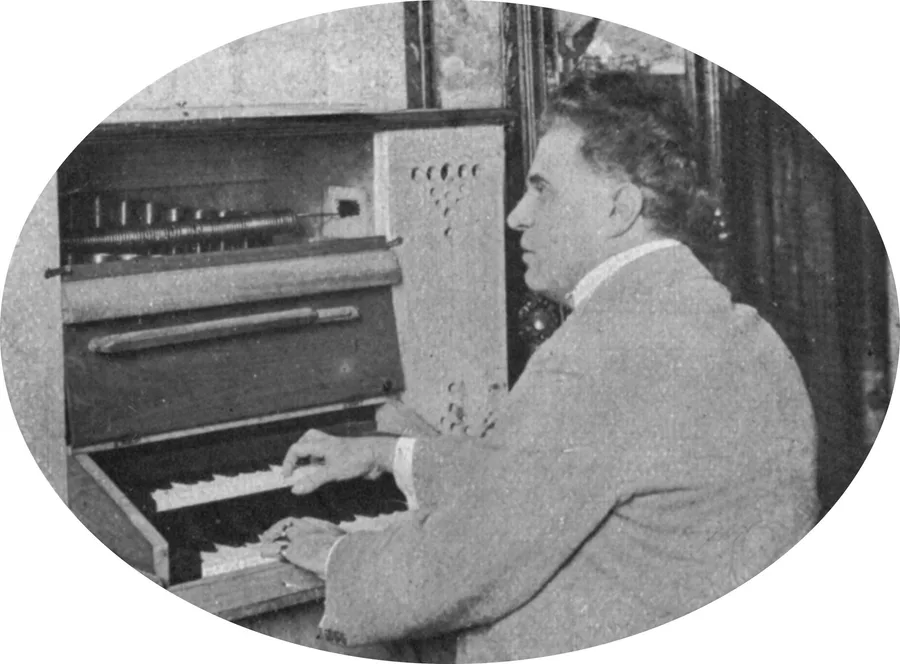
— Once you have read me the tragedy, I shall play something for you at the piano.
D'Annunzio was kind enough to read “Parisina” to me straight through, magnificently. I let him read without breathing a word. I felt flowing within me not only the sound of the verses the Poet was reciting, but the entire score. When D'Annunzio finished, I said to him:
— Thank you. You must be tired.
— Reading never tires me. On the contrary, it gives me delight. I know all my works by heart. When will you let me hear the music?
— When I come back.
— When shall we see each other? Come every day. I shall be waiting for you.
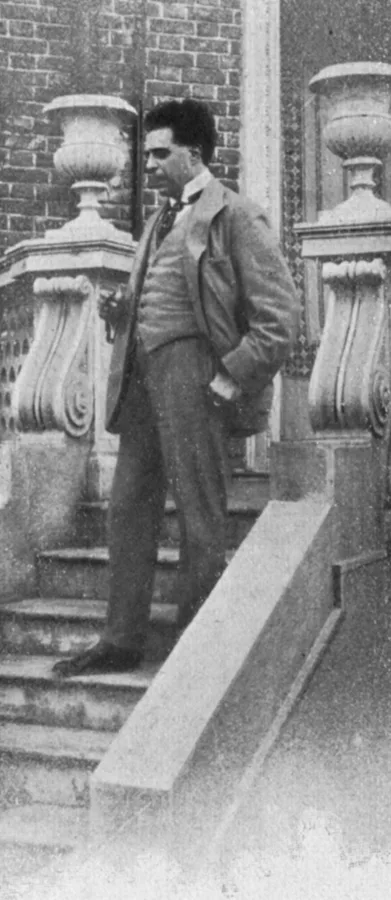
Basevi.
This took place in Paris at the Hôtel de Jena, a little-known hotel; I had noted with pleasure that there was no piano in his suite.
The next day, no sooner had I stepped into the Poet's room than I saw that a piano was there. And D'Annunzio said to me with great simplicity:
— You see, I had a piano brought in for you.
— What — right away, like this, you want to hear the music?
— Did I not read you my verses right away?
— That is hardly the same, because you had already written them!
All the same, I shall let you hear something.
I sat down at the piano and improvised. I had not written down a single line, yet I carried that music so deeply within me that it seemed to me I had already written it.
Musical conception is, to me, one of the most inexplicable things in the world. We go on living our everyday lives: we spend time with friends, we play games, we lose, at moments we lose our temper — and yet we always carry this thing in our minds. The idea works and works away: it is a delicious torment, a process that seems almost independent of us, so steadily does it advance on its own. And one goes on working always, ceaselessly. It is most curious. Distraction from this inner work simply does not exist, whatever else one may be doing. I would almost say that even in sleep one thinks of nothing else. How is it that upon waking one feels one has followed the thread of one's thought all night long? Who can say! I could have lost the entire manuscript of Parisina and still been capable of writing it all out again word for word, note for note. I believe — perhaps I am saying something old, though I do not care — I believe that music is a way of feeling, a way of thinking. To us musicians, every vision, every impression — a color, a cry, a painting, a sunset, a river — yields a musical sensation. Is the credit the musician's? The credit belongs to whatever gives rise to the idea. And so, when the power of a noble poem awakens noble musical sensations, I say that the music is summoned forth and uplifted by the poetry. In my own work, for example, I see a satellite that receives light, color, and strength from that sun which is the poem.
After I had played something at the piano, D'Annunzio said to me:
— Do not touch this music again. You have expressed what I felt. Indeed, let me tell you that in the music there is something even beyond my verse.
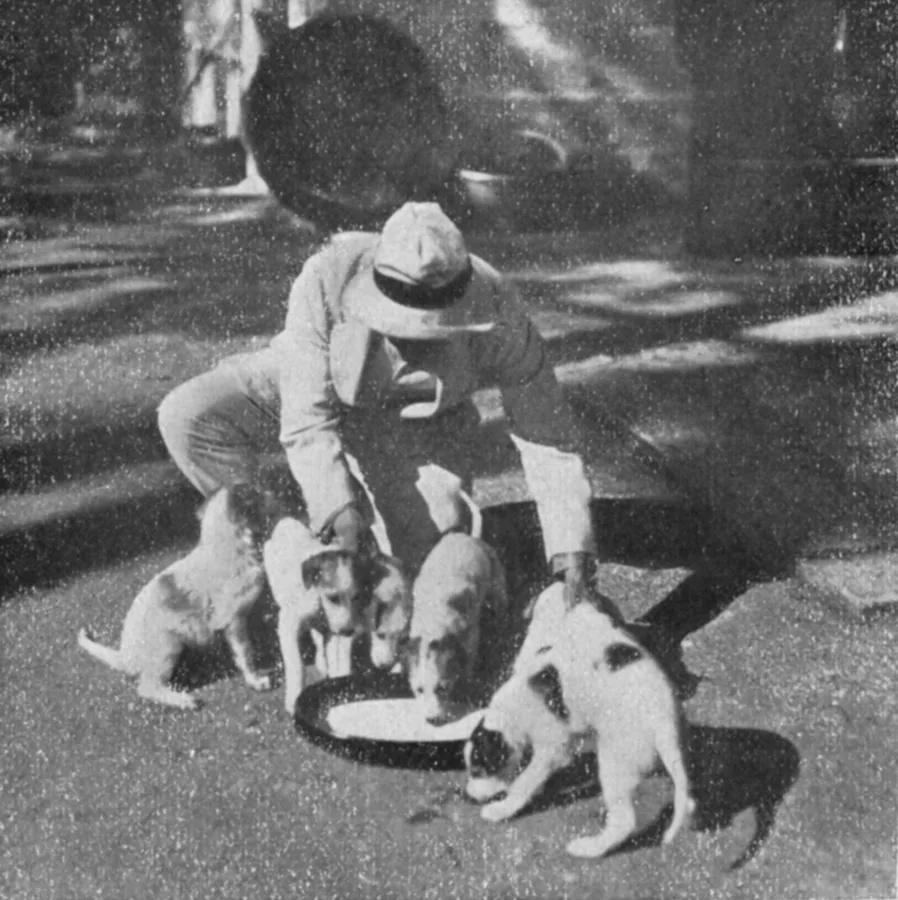
feeding his little friends.
Thus he encouraged me to press on. D'Annunzio does not know music technically; yet he possesses a musical spirit of the utmost refinement, even in what I might call a mechanical sense. One day I played a phrase for him. “Magnificent,” he told me. Naturally, when we write music down on paper, we suffer the misfortune of technique, which is a science and therefore forever spoils our first spontaneity. I wrote out the phrase and played it for him again. At once he said: “You have certainly changed it on me. The other day I could hear my verse, and now I no longer hear it.” And indeed it was true. So I reread the libretto and reshaped the phrase at the piano. At once he said: “Now it is right.” That is not mere memory; it is an exquisite musical sense. Mind you, I did once hear D'Annunzio sing and play the piano... And how does he sing, and how does he play? Come now, let us not be too indiscreet...
When I was poring over books of sacred music to find chants best suited to D'Annunzio's Latin texts, I believe no one could have given me greater help than he did. At moments I would tell him: — You do know music!
And he would reply: — I had a great gift for it, but I never studied it.
Still, there is no doubt that music set upon words holds an extraordinary grip over him. And one understands why, for no man is more of a poet than he when he declares: “I wrote this poetry, and I will not allow it to be done any other way.”
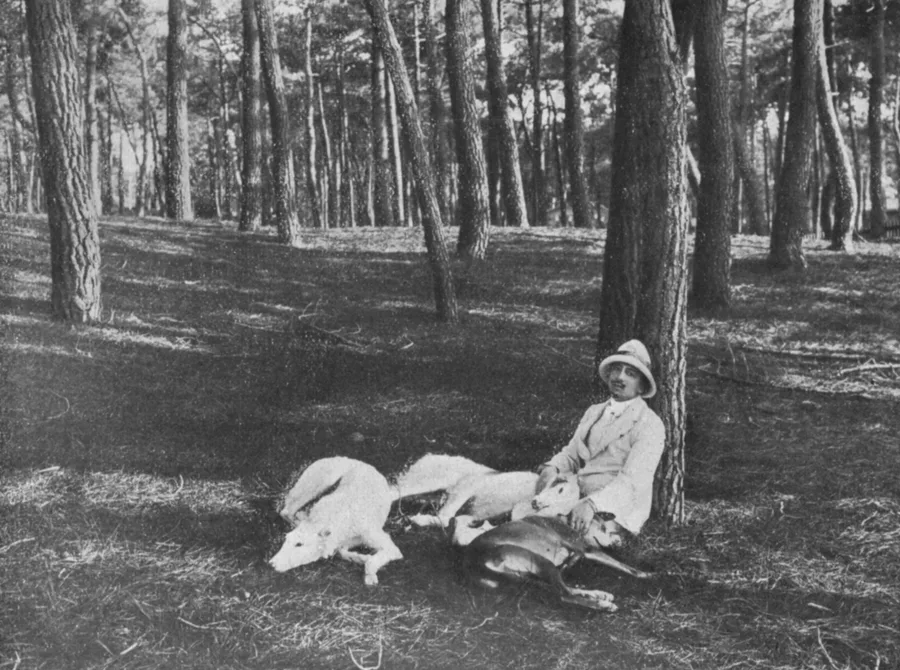
After that initial preparatory work, I returned to Italy intending to compose. Yet before I had even begun, I realized it would be impossible for me. Whenever I picked up D'Annunzio's tragedy, I felt alone, as though everything were lacking, as though the libretto itself were slipping from my grasp. “I believe the Poet's collaboration is indispensable to me,” I told myself, “or perhaps it is not so.” And one fine day I boarded a train and went off to Switzerland. It was the tenth of July. In Switzerland I went everywhere, yet I could not work. It was out of the question — so much so that I wrote to D'Annunzio about it, and D'Annunzio replied by inviting me to Arcachon. Even in Switzerland — where I was traveling incognito like a disguised prince under the name of Armand Basevi, engineer — D'Annunzio, who is a marvelous motivator and knew the straightest way to spur me on to the task, kept sending me picture postcards to keep my mind tethered to the work. I remember one of them. It read: “Here is the climax of the second act. The Idol rises.” And the postcard showed a towering breaker. Another postcard, depicting an even vaster wave, bore the words: “Look at that wave! The wave of inspiration was greater still!” And on another showing a fearful sunset: “Sunset over the Adriatic on the evening of the battle must have looked like this.” After his first telegram of invitation, which read: “I await you. The Landes are more musical than ever. Until soon. Gabriel,” D'Annunzio sent me several more: “Just back from my hermitage. Eager for news. I hope you are working and that you will come. Until soon.” “I return to the Landes next Wednesday to wait for you.” Yet I could never bring myself to go, and went on playing the bogus Basevi in Switzerland without writing a note — though perhaps beneath that restless abstinence a continuous labor of conception and maturation was going on all along. Meanwhile D'Annunzio kept inviting me to Arcachon. When I learned that there was neither electric light nor central heating there, I frankly took fright and decided not to go. Since I knew, however, that he came up to Paris every month, I decided to betake myself there. Unfortunately, Paris is no city for working. So I looked for a villa in the outskirts, at Bellevue, and settled in there. I had the comfort of having D'Annunzio with me right away; on his first stay he remained a fortnight. It was September 2, 1912, and from that day forward I was able to embark on the work with such serenity and such speed that, were I to copy out my manuscript today, it would surely take me twice as long as it took me to compose it. I cherish delightful memories of that time. By day we would stroll and play with my daughter Emy. D'Annunzio would come over and we would play bocce. To play, he would slip on white gloves, screw his monocle into his eye, bowl, and miss every single time. One day I invited a few mutual friends over for a classic match of bocce. The Poet had the honor of throwing the jack. He threw the jack and then bowled his ball close to it — “close” as a manner of speaking, since between the jack and his ball stretched at least eight meters, the entire width of the court! Everyone burst out laughing. D'Annunzio turned around, dead serious:
— Why are you laughing? Isn't the point mine?
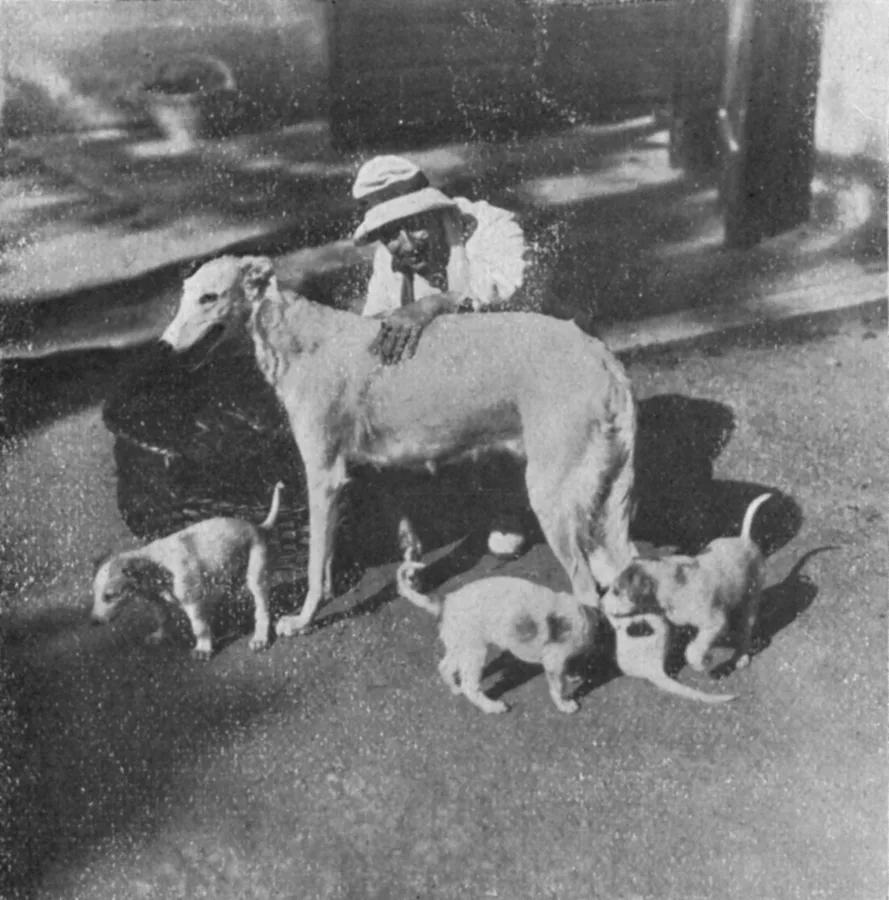
His visits were frequent and brief; then he would return to Arcachon, always asking for news of the work. In October he was away for some time, and sent me a letter headed with his laurel-wreathed motto “Per non dormire”:
“My dear Pietro. From every quarter I receive wonderful tidings of your work. A letter from the publisher speaks to me — in a lyrical tone quite unusual for a circumspect Milanese — of the second-act duet... Ah, but the third act! the fourth! I cannot tell you my impatience. I am feeling better; rest and the good ocean breeze have restored me. Until soon, until soon. I embrace you with all my heart.”
At Bellevue, during that first fortnight, I worked tremendously hard with the Poet's constant assistance. Then D'Annunzio left for Paris and Arcachon, and I felt my spirits sink — all the more because I had run aground on a difficulty that to me seemed insurmountable: I had to depict the song of the nightingale in musical notes. And I confess that never in my life have I heard a nightingale sing — something that I suspect is equally true of many who describe it magnificently! It only remains to be seen whether what they describe is really the nightingale's song. I hoped D'Annunzio could tell me how it sang.
— We must go to Versailles together — he told me.
— Let us go!
— The nightingales are not singing at this season.
— What? Can you not tell me how they sing — you who have described their song so splendidly?
— I have described it, yes, but I could never imitate it for you.
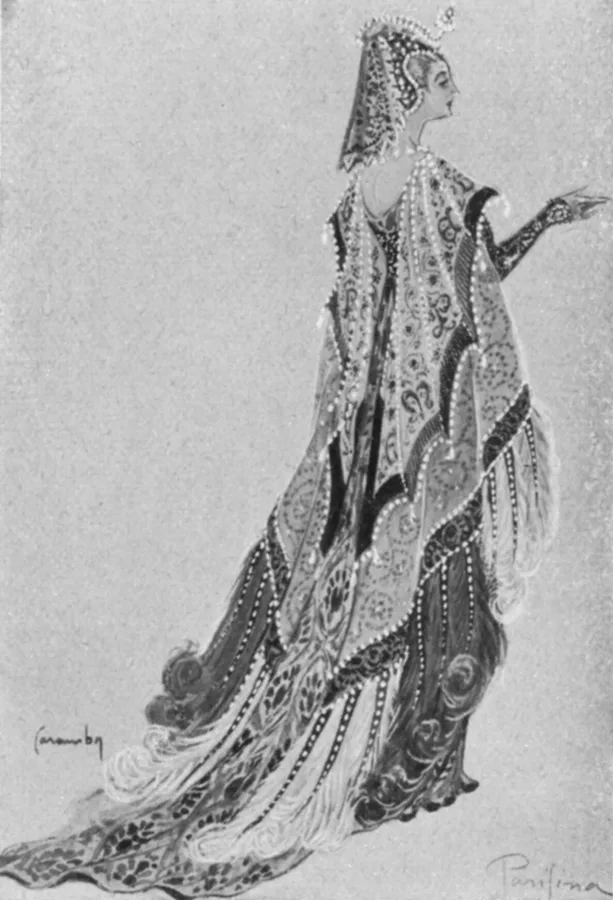
(Costume by Caramba).
In the variety theaters of Paris there are performers who imitate birdsong. So off I went in search of a “nightingale-man,” whom I was unable to find. One day D'Annunzio confided to me: “There is a marvelous book, whose title escapes me, that transcribes the nightingale's song in musical notation.” Sure enough, he tracked it down and sent it to me. It was a book on birdsong by a Professor Hoffmann — a very fine book, except that it reproduced how Beethoven, Wagner, and other composers had rendered the nightingale! Alas, I was still hearing the nightingale's song only at second hand, as others claimed to have heard it! Despondent, I wrote to the publisher, and one day the publisher arrived in Paris from Milan carrying a splendid cage and a magnificent nightingale. A mechanical one! Yet it sang to perfection; one had only to wind it up. Was that the true song of the nightingale? I summoned several experts — hunters, bird-fanciers. They displayed the most harmonious unanimity: one assured me, “It is the spitting image!” while the next declared, “It bears no resemblance whatsoever to a nightingale's song!” A fine enlightenment that was! Still, the mechanical bird served me well to play a prank on D'Annunzio. He arrived at Bellevue from Arcachon one rainy November evening, and I told him:
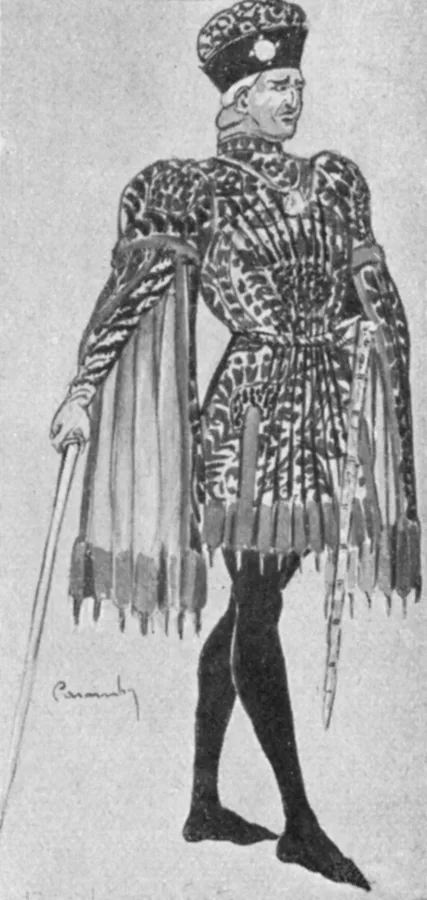
(Costume by Caramba).
— You deceived me. You told me nightingales do not sing in winter, whereas I have procured one that sings precisely in winter.
— Impossible!
— Listen for yourself. — I sent my daughter into the parlor to wind up the automaton. Out of the silence rose the song of the nightingale. D'Annunzio's face lit up in wonder:
— This is uncanny! It is marvelous!
— Would you like to see it?
Taking advantage of the dim light, I led him in to see the nightingale. He gazed at it in ecstatic admiration — until all of a sudden he heard the whir of the clockwork spring and exclaimed:
— Why, this is mechanical! — Needless to say, the instant he realized it was mechanical, he declared that a real nightingale's song was altogether different! Eventually, one fine day, I told D'Annunzio that I had composed the music for the nightingale, and I played it for him. He remained puzzled and silent for a moment, then advised me:
— You know, even if this is not strictly the song of the nightingales you will hear in the spring, you can always say: “From this moment on, nightingales shall sing the way I wrote it!”
And just as I wrote the nightingale's song, so I left it. Only, when spring came, I took care not to go and listen to them — for fear they might prove me wrong!
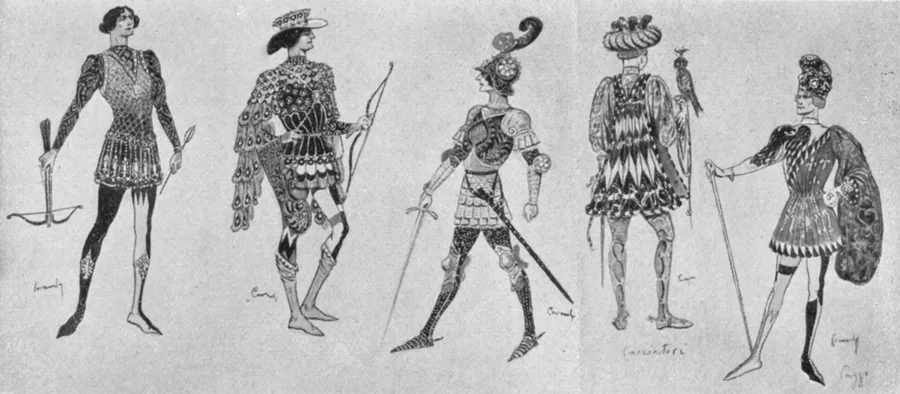
(Costumes by Caramba).
We worked so hard at Bellevue that by December 11, 1912, the opera was finished. During that period I had found a little toy as a pastime: a tin tabletop bagatelle game. When you released the spring, a little ball shot out and scored points. The very first time we played, however, D'Annunzio won two louis off me. At that I announced: “Let us suspend play!” And I refused to hear another word about it, even though every time D'Annunzio arrived he would ask: “Aren't you bringing out the bagatelle?” D'Annunzio used to arrive at Bellevue for lunch. He came by motorcab, and instead of sending it back to Paris, he left it down in the village at the foot of the hill leading up to the villa, even though it was a metered cab. The automobile stood still, and the taximeter kept running. After dinner we would settle down to work until two or three in the morning. We worked away — and so did the taximeter.
I used to ask him:
— Aren't you afraid the taximeter might break down?
— They are perfect machines — he would answer.
— And what does the driver do?
— I told him to go get something to eat first, and then curl up in the cab and sleep.
D'Annunzio was ever imperturbable. One day I remarked to him:
— Just think: for forty centimes you could come out comfortably by train.
— Ah, but to pay forty centimes one must first possess forty centimes. And as you know, my smallest unit of currency begins at five francs.
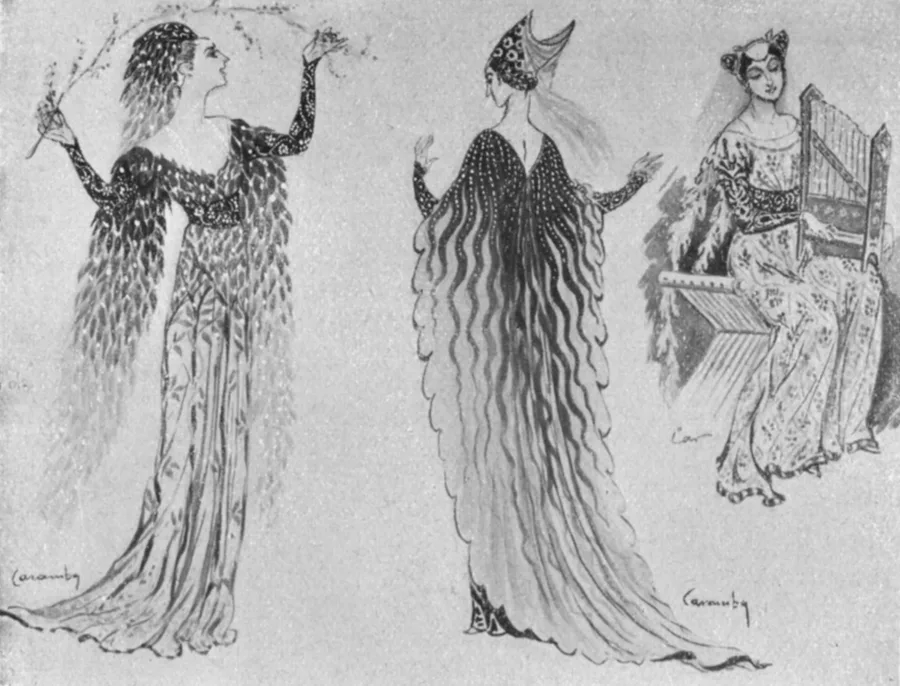
(Costumes by Caramba).
One day he sent word that he could not come the next day: he had to write articles for American and English newspapers that paid him five francs a word.
— And how many words are you writing? — Oh, two thousand!
— Bless my soul!
The next day D'Annunzio arrived: “The article?” “Already written.” He left again at half past two in the morning. As soon as we reached the waiting cab, I saw him fall into deep thought.
— I want to look at the taximeter — said he — to see how many words of my article have ticked away!
To get from my little villa down to Bellevue, we had to walk along a long stretch of country lane, because the house stood tucked away out of sight and there was not a single streetlamp. I had a tin lantern hung on a piece of wire, and with that lantern I used to escort D'Annunzio down to the square at Bellevue. One night D'Annunzio remarked:
— Just imagine if some journalist back in Italy could guess that the three of us — my daughter sometimes came along too — are tramping through the countryside past midnight with a four-penny lantern like a band of brigands... What a comedown!
At Bellevue I maintained my incognito — and once I even ran a fair risk of being taken purely and simply for a spy. A trifling matter! My cottage lay near Issy-les-Moulineaux, where the great aviation field is situated. One morning my two maids, one Spanish and one French, told me they had been summoned by the police to explain who my daughter and I were. The police thought it mighty suspicious that a foreign “engineer” and a young lady never went out by day, and ventured forth only late at night carrying a lantern in the company of an unidentified third man whose waiting motorcab ran its taximeter up to fabulous sums! Oh, that automobile, and that taximeter! You cannot imagine the astonishment aroused among all the good citizens of Bellevue by the mysterious presence of that cab, pulling up and waiting there hour after hour. At times little crowds would gather round it. Amusements are scarce in Bellevue: watching D'Annunzio's taximeter climb had become the most fashionable entertainment in town.
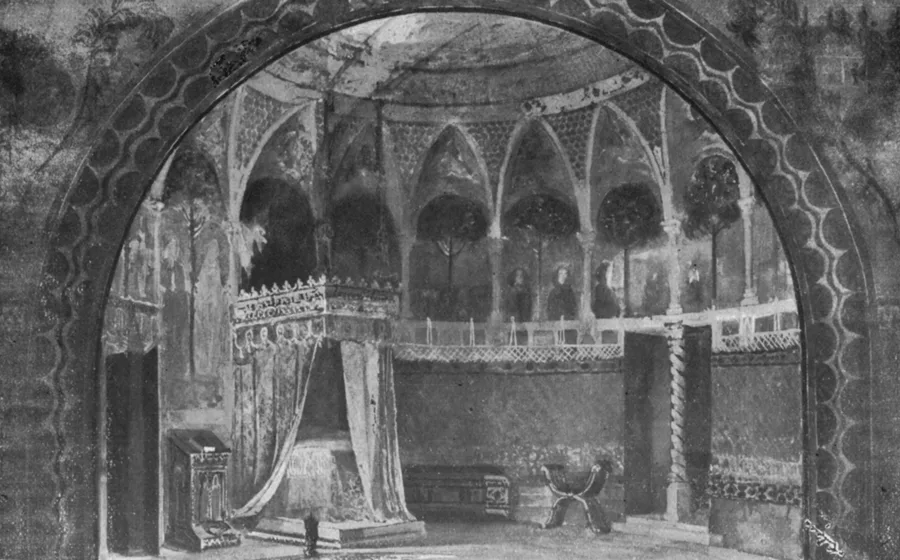
(Set design sketch by Rovescalli for La Scala).
D'Annunzio and I saw eye to eye on everything, save one matter that divided us: smoke. I have a notable passion for mezzi toscani — half-Toscano cigars. I smoke thirty-six of them — thirty-six halves, mind you! — a day. D'Annunzio, on the other hand, cannot abide their smell. Knowing this, I never once smoked in D'Annunzio's presence. True friendship does not count its sacrifices...
In private life D'Annunzio is the dearest of men, full of thoughtful delicacy. What consideration he showed me while I was working! And the almost religious devotion with which he listened to what I had composed? Extraordinary! He had an armchair in my little study; he would settle into it and never stir. Afterward I would ask my daughter what the Poet had done, for from the piano — peering through my big tortoiseshell-rimmed spectacles to read my score — I could not see him. My daughter would tell me: “D'Annunzio listens with astonishing concentration. You were at the piano an hour and a half, and I do not think he blinked once. Only at the culminating moments did he make the slightest imperceptible movement.” Those were the passages where the music pleased him best. Oh, happy days of Bellevue! Oh, childlike pastimes! Besides bocce, we also played tamburello. D'Annunzio is no great bocce player, yet at tamburello he is more original still: whenever the ball came bounding back toward him, he stepped neatly out of its way, protesting: “What do you expect? It frightens me!” Yet the memory of that season remains delightful to him too. In one of his latest letters he writes to me: “While correcting the proofs, every now and then veins of music coursed through me. Whole phrases, whole periods — especially from the second act — rose up again from the depths of my spirit with marvelous vividness. Oh, bright days, fervent nights of creation and expectation! Do you remember?” The birth of certain phrases in Parisina was rather curious. One day in Rome, a friend to whom I had read a bit of the tragedy spoke of how deeply moved he had been by Ugo's lines to Parisina in the second act, where Ugo, wounded and breathless, says:
Now you would have laid me in my coffin,
then, binding the casket upon the pack-mule,
brought me back down yonder along the long road,
accompanied amid the sweet things
of springtime...
(“Or voi / composto m'avereste nella bara, / poi, legata la cassa in sul giumento, / ricondotto laggiù per la via lunga, / accompagnato fra le dolci cose / di primavera...”)
Those lines had struck me deeply as well; I carried them complete in my mind. We walked home, I sat down at the piano — and today that phrase stands written down just as it poured out of me then. Another day I traveled to Florence to conduct a performance of Isabeau. There I met my friend Franchetti, who invited me to lunch; naturally the entire meal revolved around Parisina, all the more so since Franchetti had himself set another tragedy by D'Annunzio to music.
— You must have run into grave difficulties? — Franchetti asked me.
— No doubt I shall, seeing that I have not written a note yet! The labor of conception is the hardest part. Look: in the first act there is a whole string of popular stornelli that I would dearly love to bring off well. One or two are already running through my head, and I shall leave them just so — because even if people tell me, “that sounds like something familiar,” I shall reply: “thank you, that is the very thing I wanted. If it is to be folk-like, it must sound as though it were born in the soul of the crowd!”
— Sit down at the piano, then!
I sat down at the piano and improvised the Chorus of the Handmaidens from the first act:
What fire is this that burns and yet consumes not?
What wound is this that sheds no drop of blood?
(“Che foco è questo ch'arde e non consuma? / Che piaga è questa che sangue non getta?”)
Whether thanks to D'Annunzio's presence or to the great fervor kindled in me by a poem so marvelous in its poetry and tragic power, the fact remains that this opera of mine — vaster in scale than all my others — was composed in one hundred and twelve days; and when I reached the end, sadness came over me and, gazing at the completed manuscript, I said:
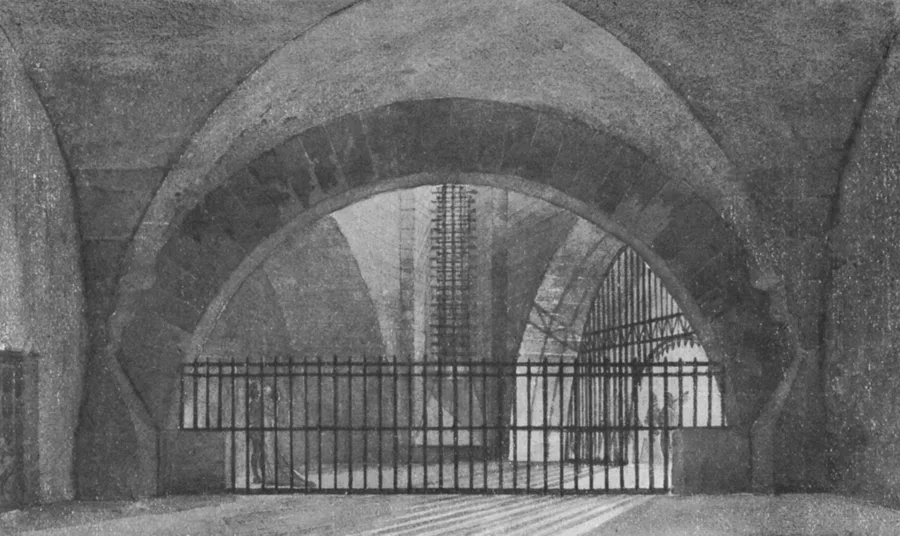
(Set design sketch by Rovescalli for La Scala).
— You gave me back a prodigious youth. Now that I have finished you, Parisina, I feel as though you were leaving me — and with you departs your prodigious youth!
Still, the orchestration remained to be written. This opera had welled up in me not only in its vocal lines, but in all its vast complexity, with the instrumentation already sketched in at many points — so much so that my draft contains everything, laid out not on two staves for piano alone, but on four or five. Seeing the sheer bulk of the labor ahead, I needed rest; for the strain of what I had done made itself felt not while I was working, but afterward. Having finished composing the opera on December 11, I began orchestrating it on the first of May — on the usual Workers' Day — and spent all the intervening months away from work, divorced from Parisina. Afterward, in order to work in Rome, I rented a villa in Milan — and discovered that Milan makes a capital summer health resort! Even so, writing out the full score cost me far more time than composing the opera itself; of that there is no doubt. I began on the first of May and finished in early November. Was the work over at last, then? Not a bit of it! Casting the singers, the sets, the rehearsals at La Scala... On top of the opera itself, I bore the responsibility of staging this brand-new tragedy — a double responsibility, while the Poet, though assisting me from afar, declined to come in person. And so down I went into the orchestra pit...
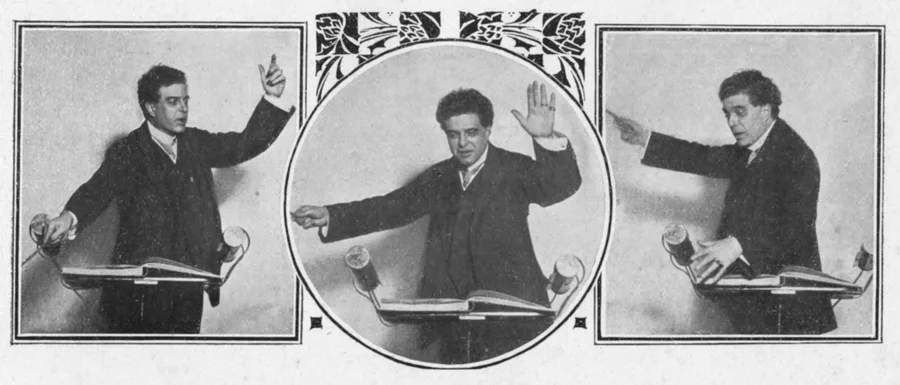
People sometimes ask me about the anguish I must feel, as the composer, in personally conducting the premiere of an opera of mine. Why, I would suffer far greater anguish were I far away! Knowing that I myself am answerable for the performance forces me to keep a level head on my shoulders. Besides, I always wish to answer for my work in person: to me it feels like a duel with the public, and I want to be on the field myself. All the same, I assure you that the opening moments — until I can sense whether or not the audience is with me — are a terrifying ordeal. I have not always conducted my own operas; I began, I recall, with Ratcliff at La Scala, and it left a profound impression on me. Still, I am always better off there than far away. Even so, dressing for that first night, stepping onto the podium before a packed and impatient house, and that dreadful hush just before the downbeat... Enough to make a man feel utterly adrift, gripped by that chill the novelists call a cold sweat. I do not sweat — but the chill I certainly feel!
Here I jot down these small confidences amid the whirlwind fervor of the final rehearsals, while I feel the weight of boundless expectation pressing upon the work. And it is infinitely sweet to me, O our Parisina, flower of passion and poetry, to recall that dear and tormenting season of creation when you were coming to birth in the moved silence of our hearts and belonged to us alone! These recollections will appear before the public once the public has already delivered its verdict. By then...
The die is cast — let us see what it shows...
PIETRO MASCAGNI.